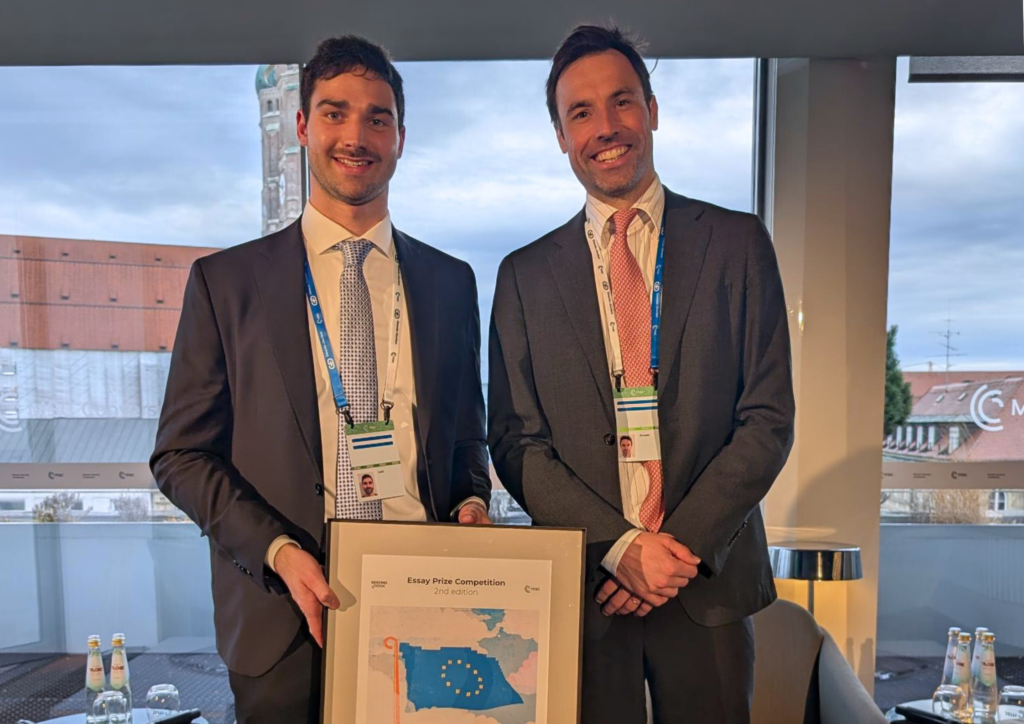
At this year’s Munich Security Conference (MSC), Virtual Routes Co-Director Max Smeets presented the award to Josh Gold, winner of the second edition of the Binding Hook–MSC Essay Prize Competition. The award followed a panel discussion dedicated to the competition’s theme.
Europe is at an important moment in shaping its digital future. Sovereignty has become a central concept in debates about independence, resilience, and competitiveness, while persistent and evolving cyber threats keep cybersecurity high on the EU agenda. Yet the link between sovereignty and cybersecurity is not straightforward. This year’s competition asked a focused question: Does digital sovereignty support Europe’s cybersecurity interests? And how should it be designed to strengthen European resilience?
The competition attracted a strong and diverse set of submissions from around the world, spanning a wide range of professional and academic backgrounds. The high quality of submissions made the selection process demanding for both the Binding Hook editorial team and the review board, chaired by Shashank Joshi, defence editor at The Economist, and Eva Maydell, Member of the European Parliament.
Many essays examined Europe’s cybersecurity posture in a shifting geopolitical environment. Common themes included the relationship between sovereignty, interdependence and resilience; the role of regulation and procurement; the importance of alliances; and the limits of existing policy frameworks.
The review board highlighted the winning essay from Josh Gold for its clear and disciplined argument. It contends that Europe’s cybersecurity is better served by prioritizing autonomy rather than maximizing sovereignty as control. The essay distinguishes sovereignty as legal authority from autonomy as operational capability, stressing that cybersecurity depends on systems that continue to function, adapt, and recover under stress.
The essay also shows where sovereignty remains essential, such as for classified systems, and where broad applications can become counterproductive. This “thin sovereignty, thick autonomy” approach is supported with examples from Canada, Denmark, France, and Estonia, and translated into practical policy recommendations aligned with existing EU frameworks.
Read the 1st prize essay as well as other winning submissions on the Binding Hook website.