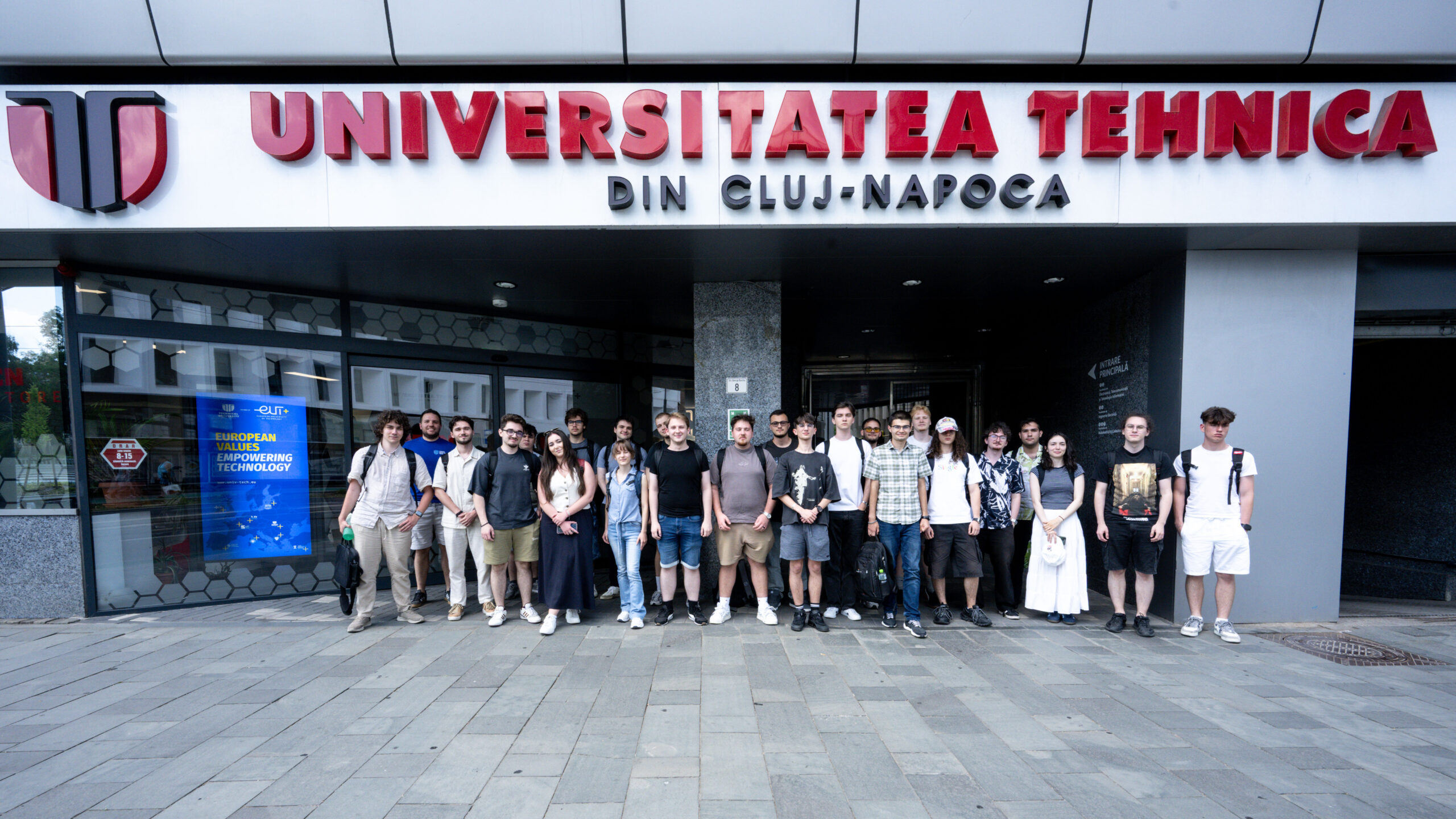
On Monday, 29 June, 2026, YuYing Mak, Project Officer at Virtual Routes, attended the closing ceremony of the Google.org Cybersecurity Seminars Program at the Technical University of Cluj-Napoca (UTCN), Romania, marking the conclusion of the program’s second cohort at the university.
The day began with a visit to UTCN’s AI Research Institute (AIRI), hosted by Vice-Rector and Professor of AI Adrian Groza. AIRI is still under construction with an expected opening date set for later this year, but it’s already shaping up to be an exciting addition to the university’s cybersecurity and AI research capacity in the years ahead.
The closing ceremony itself combined graduation with the program’s Capture The Flag (CTF) competition, in which 43 students took part. It also included a presentation of the top 10 final student projects, for which YuYing joined as part of the jury. Projects ranged from zero-trust architecture to applied honeypot research, reflecting the breadth and depth this cohort has developed over the course of the program.
Student feedback from the second cohort was consistent with their predecessors and other universities across the program: they valued highly the ability to put their cybersecurity skills into practice, and more generally the hands-on training reshapes how they think about cybersecurity as a discipline: one that demands soft skills as much as technical ones. Several noted that the hardest part of working with local community organizations (LCOs) was simply convincing them they needed help, and that the organizations most willing to engage were often those that had already experienced an incident.
Adrian Coleșa, Faculty Champion, closed the evening with an apt message from Antoine de Saint-Exupéry’s The Little Prince: what you take from a journey is not just what you can measure at the end. Although UTCN’s second run of the Cybersecurity Seminars has now come to an end, the work it produced is set to continue. UTCN is planning to publish a substantial body of research arising from the seminars, including project findings and a book drawing on the program’s resources. Two papers co-authored by students taking part in the program have already been accepted for publication, which is a strong indication of the calibre of work this cohort has produced – we look forward to seeing where their research goes next!