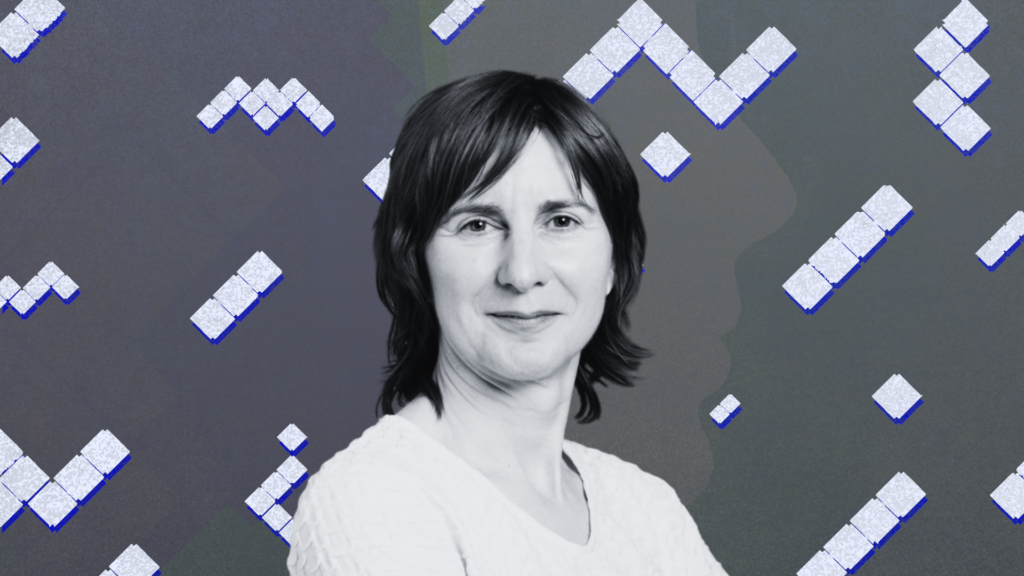
Today’s “AI over Lunch” has been downgraded, or perhaps upgraded, to “AI over Tea.” Arranged at the last minute in a noisy café, my guest, Dr. Julia Stamm, has come to Brussels for business. We meet at Karsmakers, across from the European Parliament, famed for its coffee and bagels. She orders mint tea and marble cake; I settle for a dirty chai latte and an apple-cinnamon cake the size of a paving stone. The coffee here has earned its reputation among Italians in the EU bubble, an approval harder to win than a unanimous Council vote.
“Innovation is too important to be left to engineers alone.”
Tea poured, we quickly move on to the serious business of the afternoon. Julia is in Brussels to promote and connect women who are building AI for the common good. She is determined to show that innovation is not the preserve of Silicon Valley men but can be driven by diverse voices addressing society’s greatest challenges responsibly. We had just met through LinkedIn, after she announced the first She Shapes AI event in Brussels. As I take a first bite of my cake, she sketches a career that has taken her from academia to the European Commission, the German G20 presidency, and eventually into the world of entrepreneurship. Julia has spent her career in responsible research, innovation, and technology, yet she is quick to note, “I don’t come from a tech background”. For Stamm, this absence is also a strength: “Innovation”, she argues, “is too important to be left to engineers alone”.
That conviction first took shape in 2019, when she founded The Futures Project. The idea, she explains, was born out of her participation in a panel where male tech experts were enthusiastic about their dazzling technological tools, but unaware of the problems they could solve. “None of it was addressing what I would call real-world issues,” she recalls. Her answer was to flip the conversation: start with values and vision, where society wants to go, and only then ask what role technology should play. But like many mission-driven organisations, the Futures Project struggled for funding. Stamm shut it down after two and a half years, a decision she describes as “painful”, before turning to consulting and eventually founding She Shapes AI. What runs through these experiences is her determination to create spaces where different voices, especially those of women, actively shape the technological future.
“Too often, women in AI are doing important work in the trenches without recognition, and without recognition, investment rarely follows.”
She Shapes AI, launched just last year, sets out to do exactly that, amplifying female entrepreneurship worldwide and fostering strategic AI leadership. The initiative is deliberately structured as a for-profit social enterprise. “A political statement,” she calls it, against the assumption that impact work must be unpaid or relegated to the non-profit sphere. Its flagship project is an annual Global Awards Programme spotlighting women who are building or applying AI through a responsible lens to solve ‘actual problems’, from protecting endangered languages in the Philippines to safeguarding independent journalism. “If you can’t see the problem, you can’t identify the solutions,” she says, explaining why visibility matters as much as funding. “Too often,” she argues, “women in AI are doing important work in the trenches without recognition, and without recognition, investment rarely follows”.
From there, our conversation quickly widens to the broader state of AI. Stamm is wary of the hype. “Only about five per cent of companies see a return on investment from AI right now,” she says. “That tells us it’s not just a tool problem, it’s a mindset problem.” Too many organisations, in her view, rush to adopt technology without asking what purpose it serves and how it can be meaningfully integrated in organisational workflows. “We need to think about the why before the what. Otherwise, we’re just building because we can, and that’s not innovation, that’s distraction.”
Regulation is another recurring theme. Stamm is clear-eyed about the need for rules, but impatient with what she sees as an at-times overly academic debate. “I’d rather work with someone who ships at 80 per cent with a strong ethical north star than someone entirely paralysed by regulation,” she argues, “because the irresponsible actor will ship anyway.” “What matters,” she insists, “is creating a human-centric culture where privacy, security, ethical principles and human rights are built in from the start. Without that foundation, no legislation can rebuild public trust.”
And then there is Europe’s quest for “AI sovereignty,” a concept Stamm approaches with some scepticism. “At scale, big tech is largely American or Chinese,” she says. She argues that Europe is better placed to carve out leadership in specific areas: linguistic diversity, sectoral applications, or domains where it already holds expertise. “That’s where sovereignty really lies.” In practice, this means backing AI for climate modelling, education, healthcare, or cultural preservation; domains where Europe already has strengths, and where the benefits flow directly to citizens. It also means recognising that the race is not only about building the biggest models, but about shaping how and where AI is applied.
“We need to think about the why before the what. Otherwise, we’re just building because we can, and that’s not innovation, that’s distraction.”
For the cybersecurity community, Stamm’s message is both cautionary and urgent. The hype around AI, she warns, can obscure the very real risks that come with new tools deployed at speed and scale. “Startups need privacy and security baked into their DNA,” she says. “Otherwise we will never build trust.” Without that trust, adoption lags, and so do the social benefits she hopes technology can deliver.
Where does she hope AI will be in five years? Stamm doesn’t hesitate. “I want responsible AI to be the default, not the exception. I want women in leadership to be normal, not a headline. And I want us to stop fetishising the tools and start asking what problems we are actually solving.”
By the time she drains the last of her mint tea, her marble cake is only half-finished. My own plate, by contrast, is spotless. In AI as in cake, Stamm skips indulgence and keeps her focus on the substance.
The AI over Lunch interview series is a project part of Virtual Routes’ AI-Cyber Research and Policy Hub. If you would like to sponsor this series, please reach out to
hu*@vi************.org
.
Have someone in mind we should interview? We’re happy to hear your suggestions!