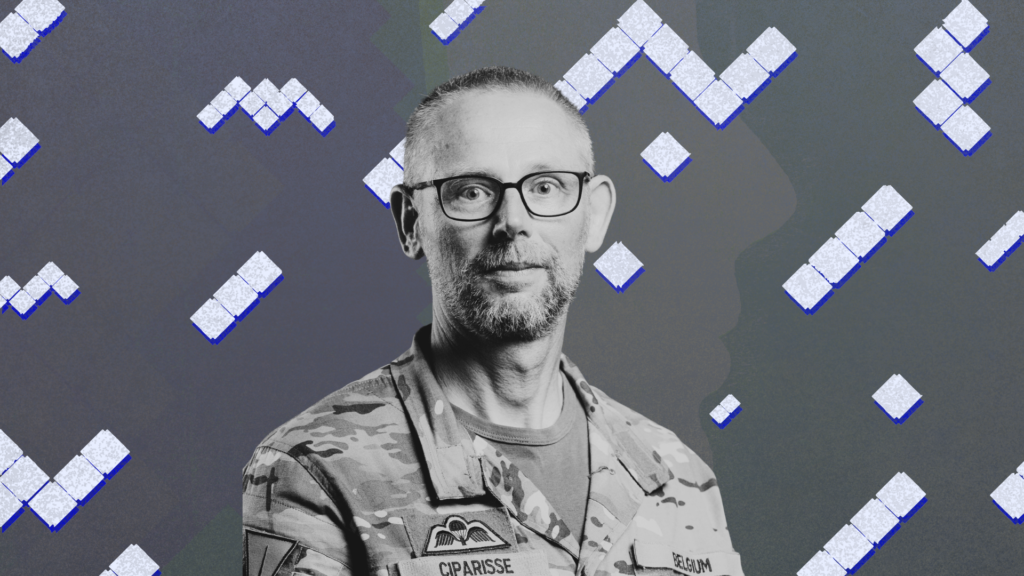
This week’s AI over Lunch takes us to Moutarde, a new addition to Ixelles, a Brussels neighbourhood where trendy restaurants tend to appear overnight. My guest, Aline Duchateau, former Director ICT and Police Information and Chief Superintendent at the Belgian Federal Police, is keen to try it, though she cannot help noting that such dynamism rarely reaches the north of the city. “The area could use some novelty,” she says with a sigh, before turning back to the menu.
Menus in hand, we hesitate, then surrender to the waiter’s favourites: collier de cochon ibérique with carrot mousseline and chimichurri for her; aile de raie with capers, mashed potato and beurre noisette for me.
That brief hesitation over lunch contrasts with a career spent making decisions in moments of institutional uncertainty. Duchateau joined the Federal Police in the early 2000s, when three separate forces were being merged and many rules were still being written. “Everything was new,” she recalls. “Structures, responsibilities, reporting lines. We were building while operating.”
Before entering the police, Duchateau studied philosophy and literature. The training, she suggests, never quite left her. “Philosophy teaches you to define your concepts before you act,” she says. “You have to know what problem you are trying to solve.” That instinct for conceptual clarity shapes how she views technology: AI, for her, is first a question of purpose, only then of capability.
“People expect miracles from IT, but miracles are not a strategy.”
The current wave of enthusiasm around AI leaves her cautious. “People expect miracles from IT,” she says. “But miracles are not a strategy.” She has seen similar cycles before: the arrival of the internet, early digitalisation drives, the migration to large vendor ecosystems. “Every time, the technology was framed as a turning point,” she recalls. “And every time, the real work was institutional.”
For Duchateau, AI is not necessarily a revolution descending upon policing. “It is another layer,” she explains, “entering an already complex ecosystem.” The question is not whether the technology is powerful. “Of course it is powerful,” she says. “The real question is whether the institution is ready for it.”
AI does have operational value, but she is precise about language. “I prefer to speak about big data and analytics,” she says. “AI is often presented as something magical. In reality, it is processing large volumes of data quickly.” Police work, she notes, is often about finding a needle in a haystack. “AI can help you sort the hay. It does not decide what the needle is.”
“Police work is often about finding a needle in a haystack. AI can help you sort the hay. It does not decide what the needle is.”
Unlike in many sectors where IT enables a core business, policing is built on data. Victim statements, intelligence inputs, operational logs and judicial files are the work. “In law enforcement, data is not just support,” she says. “It is information; it constitutes the investigation itself.” That also justifies the need for precise data governance. “If you are not governing your data, you are not governing your police force.”
Pattern recognition, voice-to-text and anomaly detection can reduce repetitive work and free analysts for judgement. “It can support investigation. It cannot replace responsibility.”
The bigger risk is starting with the tool rather than the problem. “You do not start with the tool,” she says. “You start with the friction.” Where are investigations slowing down? Where is capacity lost? Where do systems fail to connect? AI, she argues, should build on stable foundations. “If you use it to compensate for structural gaps, you are building on unstable ground.”
Readiness is also about control. Digital transformation has already increased technological dependency in policing. Cloud services, licensing models and external platforms have reshaped public-sector operations. AI may accelerate that trend. “The base product is often cheap,” she notes, “but dependency is expensive.”
For law enforcement, that dependency is operational, not just financial. When investigative tools rely on proprietary models or opaque systems, accountability becomes harder. “If you do not understand the system you are using, you cannot fully control the risk.”
There is also the risk of cognitive drift. As AI tools settle into workflows, their outputs can begin to carry the weight of decisions. “AI can suggest,” she says. “It cannot decide.” Under time pressure and heavy caseloads, the distinction can blur. Over-reliance, she warns, happens gradually.
As we order chocolate mousse topped with olive oil and salt, the discussion turns to ethics. For Duchateau, responsible AI is not a compliance exercise but a safeguard. Before building any system, she proposes three questions: what is the goal, is it necessary and is it proportional? “Everything you do in policing has to be goal-oriented and proportionate. If you cannot justify it, you should not be building it.” Ethical reflection, she argues, should come before development. “It saves you from investing in something you may not even be allowed to use.”
“Everything you do in policing has to be goal-oriented and proportionate. If you cannot justify it, you should not be building it.”
Modernisation, she suggests, is further complicated by policing’s fragmented structure. Unlike the military, where doctrine and operational processes are formally defined, police forces are often fragmented across jurisdictions, mandates and political layers. “It is not a single system,” she says. “It is many systems that have to cooperate.” In Belgium’s federal and linguistic landscape, the challenge is evident.
Introducing AI in such environments is not a simple upgrade. It requires coordination across investigative services, intelligence units, local forces and judicial actors, each with distinct constraints and data cultures. “If you do not agree on the process, technology will not create agreement for you.”
She might sound pessimistic, but is rather clear-eyed about pace. As we finish our coffees, I ask what policing might look like in five years’ time. Duchateau does not predict radical change. Progress, she suggests, will be quieter than headlines imply. Some tools will become routine; others will fade as limits appear. “If we do the groundwork properly,” she says, “AI will become ordinary. That is the goal.”
As we step back onto the street, Ixelles already seems to be looking towards its next opening. The enthusiasm is familiar, as is the promise of renewal. In urban planning as in AI, Duchateau reminds us that we should not give in to passing trends, but build patiently, solidly, and for the benefit of the whole – not just for convenience or hype.
The AI over Lunch interview series is a project part of Virtual Routes’ AI-Cyber Research and Policy Hub. If you would like to sponsor this series, please reach out to
hu*@vi************.org
.
Have someone in mind we should interview? We’re happy to hear your suggestions!